Treated Flame Resistant (FR) Apparel is a specialized protective clothing range that protects people who might face fire and heat hazards in their workplaces. A unique chemical treatment is applied to the fabrics to make them flame-resistant. The chemical treatment works by helping it resist ignition and self-extinguishing when the ignition source is removed.
Apparels made out of treated FR Fabrics is the most popular in the FR protective wear category. These factors below contribute to its importance of being the most dominant.
Natural Fibers: Largely the products in this category are made of 100% cotton or blends with cotton, viscose & nylon, making them highly comfortable to wear for longer durations.
Cheapest upfront cost: Since these products are generally made out of cotton & cotton blends with a fire-resistant coating, the upfront cost is quite nominal as compared to other ranges in the FR protective wear category
Compliant with most norms: It is perfect for businesses looking for compliance without having to spend a fortune, as the product complies with all basic norms.
A natural product with the cheapest upfront costs and compliant with basic norms makes Treated FR fabrics the winner in the protective wear category.
It is a completely natural fabric with a FR chemical coating on top. It can be made in varying thickness starting from 240 GSM and upto 475 GSM.
88% Cotton 12% Nylon FR
This particular blend is quite common in American markets. It offers a balance of comfort and durability. The cotton part makes the product breathable
Cotton Blends FR
Cotton is blended with other fibers like, viscose, nylon, tencel to improve the overall performance of the product. Once the fabric is made an FR chemical coating is done on top of the product.
The blends can be made based on the requirements of the end user.
Suggested Industries
Oil & Gas
Electrical & Utility
Manufacturing & welding
Construction
Compliant with safety norms - Inherant fire retardant
Protective clothing certified according to EN ISO 11612 gives the wearer protection against brief contact with heat and flame. The heat can be convective, radiant, molten material, or a combination thereof.
The garment is classified for the following parameters
specifies two classes with specific performance requirements, i.e. Class 1 being the lower level and Class 2 the higher level.
Class 1 is protection against less hazardous welding techniques and situations, causing lower levels of spatter and radiant heat.
Class 2 is protection against more hazardous welding techniques and situations, causing higher levels of spatter and radiant heat.
NFPA 2112
PROTECTION OF INDUSTRIAL PERSONNEL AGAINST FLASH FIRE
This standard specifies the minimum performance requirements and test methods for FR fabrics and components, as well as the design and certification requirements for garments developed to protect workers from a flash fire hazard.
It requires FR fabrics to pass a comprehensive battery of thermal tests, including the following:
ASTM D6413- Vertical Flammability test Maximum two seconds after flame and four-inch char length. ASTM F2700 – Heat Transfer Performance (HTP) test Minimum HTP of 6 cal/cm² spaced and 3 cal/cm² contact. Thermal Stability test – Fabric must not melt or drip, separate or ignite after five minutes exposure in a 500°F or 260°C oven. Thermal Shrinkage test- Fabric must not shrink more than 10% after five minutes exposure in a 500°F or 260°C oven. ASTM F1930-11- Thermal Mannequin test Maximum 50% predicted body burn after three-second thermal exposure.
NFPA 70E
The National Fire Protection Association (NFPA) 70E is a comprehensive standard that establishes best electrical safety practices standards on how to protect workers from electric arc flash and arc blast exposure and resulting potential injury and death.
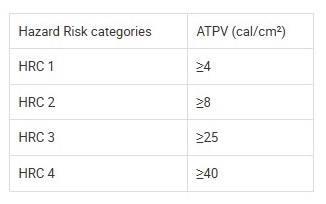
There are 4 Arc Hazard Risk Categories under NFPA 70E defined by the ATPV ratings:
Most people working with electricity only require clothing that meets category 1 (ATPV 4 cal/cm²) or 2 (ATPV 8 cal/cm²) protection characteristics.
NFPA 70E electrical safety standards are aimed more towards those workers who work in category 3 (ATPV 25 cal/cm²) or 4 (ATPV 40 cal/cm²) hazard situations. Their clothing must meet ATPV rating minimums throughout the life of the garment.